
Changing a packaging material is not simply a matter of replacing one roll with another and checking whether the machine continues to operate. In any industrial process, a new material can affect the behaviour of the line, sealing, performance, packaging quality or even product preservation.
For this reason, before moving to full production, it is common to carry out a packaging material approval process using a trial roll. The objective is to validate the material under real production conditions and check that it meets the technical and production requirements of the process.
What is packaging material approval?
Packaging material approval is the process by which a customer validates that a specific material works correctly on their production line and meets the established requirements.
During this process, it is checked that the material is compatible with the machine, the product and the production conditions. Aspects related to quality, safety and packaging performance are also evaluated.
In practice, approving a material means answering a fundamental question:
Does this material work correctly in your packaging process?
To answer this question, it is not enough to know the technical characteristics of the film on paper. It is necessary to test it under the real conditions in which it will be used.
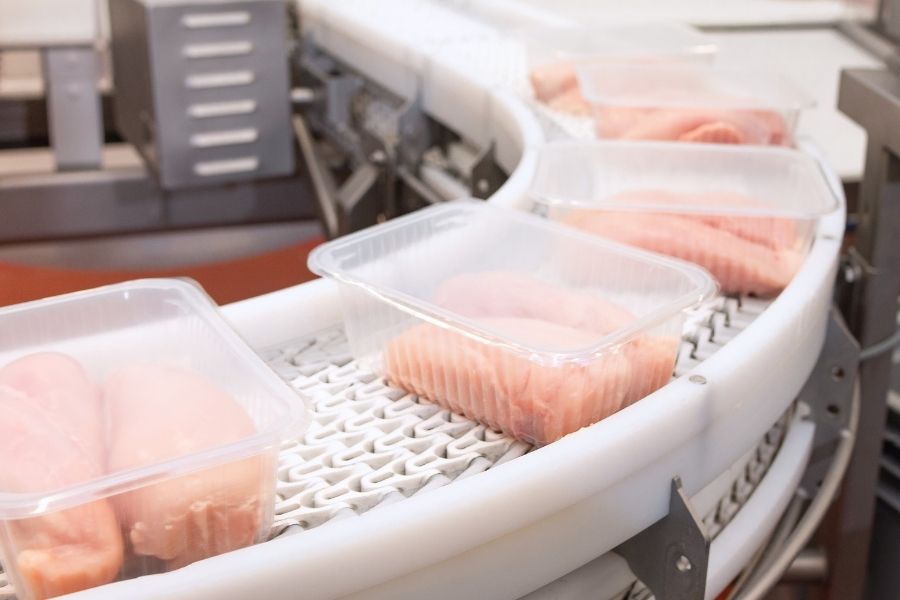
What is checked during the approval of a packaging film?
An approval process makes it possible to evaluate different aspects of the material and the packaging process.
Machine performance
The first aspect analysed is how the material behaves on the production line. Among other factors, it is checked whether it moves correctly, maintains stable feeding and works properly with the different components of the machine.
Each line has specific characteristics, and the behaviour of a material may vary depending on the machinery, production speed and parameters used.
Sealing
Sealing is one of the most important points in any packaging process.
During the test, it is verified that the material allows for correct and consistent sealing, with the necessary resistance and without defects that could compromise the integrity of the package.
The necessary sealing parameters can also be evaluated, such as temperature, pressure or contact time, depending on the material and the equipment used.
Mechanical resistance
The package must withstand the conditions to which it will be subjected during manufacturing, handling, storage and transport.
Therefore, the approval process also makes it possible to check aspects such as material resistance, its behaviour in the event of possible punctures or breaks, and the overall integrity of the package.
Visual appearance of the package
Packaging quality also has a visual dimension.
During the test, aspects such as transparency, printing, the presence of wrinkles, film tension or the final appearance of the package can be analysed.
The objective is to check that the material allows the expected visual result to be achieved in the finished product.
Barrier and preservation
Depending on the packaged product, the material may require specific barrier properties against oxygen, moisture or other elements.
The approval process makes it possible to verify that the selected structure is suitable for the product’s preservation requirements and for the expected packaging and storage conditions.
Process stability
It is not enough for the material to work correctly for just a few minutes. It is also necessary to check that the process remains stable.
An approval test can help detect whether the material causes variations in production, changes in machine parameters or difficulties that may arise when working for longer periods.
Performance and waste
Another important aspect is the impact of the material on the overall performance of the line.
During the test, factors such as production speed, material consumption, waste and the number of rejected packages can be analysed.
In this way, the approval process makes it possible to assess the behaviour of the material not only from a technical perspective, but also from a production perspective.
Why not move directly into production and carry out a trial process for film approval?
When a packaging material is already working correctly, any change should be made with a certain degree of caution.
Replacing a material without carrying out a prior test can generate problems that are not always evident from the technical data sheet. A material may have characteristics similar to another and yet behave differently on a specific machine.
Moving directly to a full production order can involve risks such as:
- Line stoppages or interruptions.
- Sealing problems.
- Increased waste.
- Reduced machine performance.
- Product rejects.
- Quality problems.
- The need to make unforeseen adjustments.
- Additional costs resulting from a material that ultimately proves unsuitable.
That is why approval makes it possible to carry out the change in a controlled manner.
The idea is not to modify a process that is already working without a clear reason, but rather to check beforehand what happens when the new material is introduced.
What is a trial roll for packaging material approval?
A trial roll is a limited quantity of material manufactured specifically to carry out an approval test.
Instead of immediately producing the entire volume required for a campaign or a full order, a sufficient quantity is manufactured so that the customer can test the material on their own line and under real production conditions.
The test makes it possible to check the behaviour of the material with:
- The usual machinery.
- The actual production parameters.
- The product to be packaged.
- The expected operating speeds.
- The sealing systems and other line components.
In this way, your company can validate the material before committing to a higher-volume production run.
What are the advantages of working with a trial roll?
Carrying out an approval process using a trial roll provides benefits for technical, production, quality and purchasing teams alike.
Reduces risk
Your company can check how the material performs before placing a higher-volume order.
This makes it possible to detect potential problems at an early stage, when it is still easier to make adjustments or modify the solution.
Speeds up decision-making
A real-world test provides information that, in many cases, cannot be obtained solely from technical specifications.
The results make it possible to make decisions based on the material’s actual performance.
Allows parameters to be adjusted
During the test, the adjustments required to achieve the best material performance on the line can be identified.
In some cases, these adjustments may be related to sealing temperature, production speed or other process parameters.
Avoids additional costs
Detecting a problem before carrying out full production can help avoid costs associated with unused materials, rejected products, waste or line stoppages.
The trial roll therefore acts as a way of reducing uncertainty before making a larger investment.
Provides reassurance to quality and production teams
Validation allows the different teams involved to have real information about the material’s performance.
This makes it easier for production, quality, purchasing and other departments to assess the change with greater confidence.
Facilitates internal approval
When a new material needs to be approved within an organisation, having results obtained from a real-world test facilitates evaluation and decision-making.
Approval provides concrete data on the material’s performance, rather than basing the decision solely on the supplier’s technical information.
What role does the supplier play in the approval of a material?
Approval should not be limited to sending a roll and waiting for the test results.
The supplier can play an important role throughout the entire process, especially when changing the material requires adapting the structure to the characteristics of the machine or product.
At Ttpack, the approval process can include different forms of technical support, such as:
- Recommendation of the most suitable material structure according to the product and machinery.
- Technical support during the preparation phase of the test.
- Support during material validation.
- Technical adjustment of the material and production parameters on site when necessary.
- Analysis of the results obtained during the test.
The objective is for approval not to become simply a trial-and-error test, but rather a technical and controlled validation process.
The selection of a packaging material depends on different factors. The product, type of machine, sealing system, production speed and preservation requirements can influence the most suitable solution.
Therefore, knowledge of the entire process is essential.
Approval as a preliminary step to changing material safely
Packaging material approval is not simply a formality prior to production.
It is a way of checking, under real conditions, that a new material can be correctly integrated into your packaging process and meet technical, quality and production requirements.
Using a trial roll makes it possible to validate the change with much lower risk than would be involved in moving directly to full production.
Because when a production line is working correctly, any change should be supported by data.
Are you considering changing your packaging material? At Ttpack, we support you through the approval process with a trial roll and technical adjustment on site to validate the change with confidence.