
When it comes to food packaging, choosing a technology is about much more than simply deciding how to seal a product. The packaging system must meet a combination of requirements, including shelf life, oxygen protection, product characteristics, in-store presentation, available machinery, cost and sustainability requirements.
In applications such as fresh meat, fish and cheese, two solutions may be considered: vacuum thermoforming and Vacuum Skin Packaging (VSP).
Both technologies protect the product and extend its shelf life, but they differ significantly in how the film conforms to the food, the visual result, material requirements and the product’s final market positioning.
Therefore, the question should not simply be which technology is better, but rather: Which packaging system and film structure best meet the needs of the product?
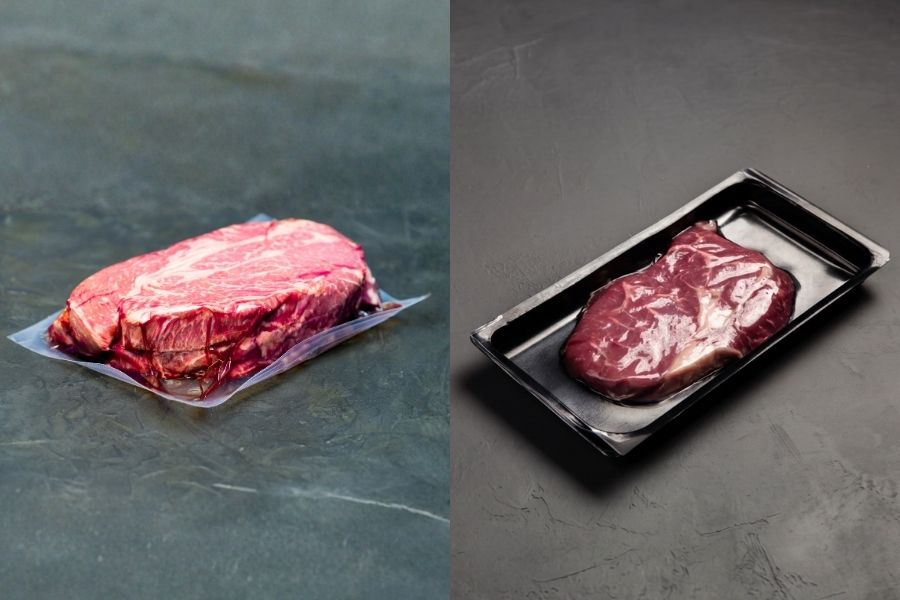
What is vacuum thermoforming?
In thermoforming, the packaging is manufactured directly on the packaging line from a roll of bottom web film.
The material is heated and formed to create the cavity into which the product is subsequently placed. The air is then evacuated, and the top web is sealed.
In a vacuum thermoforming system, the aim is to reduce the oxygen present around the product before sealing. The top and bottom films form a protective barrier around the food, but the material does not necessarily adhere completely to its surface.
This makes conventional thermoforming a particularly versatile solution for manufacturers that require automation, high productivity and a variety of packaging formats.
What are its advantages?
The main benefits of thermoformed packaging include:
- High productivity and automation.
- The ability to produce packaging in different formats and depths.
- Good adaptability to products of different sizes.
- A wide variety of film structures.
- The option to use high-barrier materials.
- A good balance between performance and cost.
- Easy integration into high-volume industrial production lines.
Es una tecnología especialmente consolidada para productos destinados tanto a distribución como a retail.
However, the film does not necessarily follow the contours of the product. Depending on the product’s geometry and characteristics, space may remain between the food and the top film.
This may be perfectly suitable from a functional perspective, but it does not always deliver the most attractive presentation when the product needs to stand out visually on the shelf.
What is Skin Thermoforming (VSP)?
Vacuum Skin Packaging (VSP) uses a top film specifically designed to conform to the product.
During the process, the film is heated and moulded around the surface of the food, creating a “second skin” effect. The result is packaging in which the product is securely held in place and clearly visible.
This feature significantly changes how the packaging is perceived.
Rather than leaving a clearly visible gap between the product and the film, the material follows the product’s contours, even when the food has an irregular shape or varying heights.
For this reason, skin packaging has become particularly well established in applications where packaging must not only protect the food but also showcase it and differentiate it at the point of sale.
What are the benefits of VSP?
The main benefits of vacuum skin packaging include:
- Excellent conformity to the product’s geometry.
- A premium presentation.
- High product visibility.
- Greater product stability inside the tray.
- Reduced visual impact of liquids and purge.
- Suitability for high-value-added products.
- Compatibility with trays made from different materials.
- Particular suitability for retail-ready products.
The trade-off is that the system requires films specifically designed for skin applications, appropriate processing parameters and compatible equipment.
When is vacuum thermoforming the right choice?
Vacuum thermoforming may be the most suitable option when the priority is to optimise production, costs and product preservation, without requiring the film to conform completely to the product’s surface.
It can be particularly beneficial for:
Larger cuts and formats
Meat products, cheeses and fish sold in large cuts or portions can benefit from the flexibility of the formats available through thermoforming.
Products intended for distribution
When packaging is primarily designed to protect the product during storage, transport and distribution, thermoforming can provide an attractive balance between performance and cost.
High-volume production
La automatización y velocidad de las líneas de termoformado hacen que esta tecnología sea especialmente adecuada para grandes volúmenes de producción.
Applications where premium presentation is not a priority
Not every product needs packaging designed to stand out visually on the shelf. When price, functionality and efficiency carry greater weight, conventional thermoforming may be sufficient.
When does Skin Packaging make sense?
Vacuum Skin Packaging (VSP) becomes particularly relevant when packaging is an integral part of the product’s value proposition.
Premium meat cuts
The product remains fully visible and securely held in place, allowing key characteristics such as the cut, colour and texture to be showcased.
Fish and seafood
The clean presentation and the film’s ability to conform to the product can be particularly valuable for products that need to convey freshness and quality.
Products with irregular geometries
When the food has varying heights, shapes or surfaces, skin packaging’s ability to conform to the product can offer a clear advantage.
Prepared foods
VSP can be used to package prepared foods and products containing different components, particularly when visibility of the contents is important.
Premium brands and private-label products
When packaging needs to support a higher-value market positioning, the presentation offered by skin packaging can become a key differentiating factor.
What about sustainability when selecting films?
La selección del film también está cada vez más condicionada por los objetivos de sostenibilidad y reciclabilidad.
The development of mono-material structures is gaining momentum, particularly in applications where the aim is to facilitate packaging management at the end of its life cycle.
However, reducing the number of materials or moving towards mono-material structures requires balancing these objectives with the performance the application demands.
A film must continue to provide:
- Barrera adecuada.
- Puncture resistance.
- Reliable sealing performance.
- Consistent performance on the packaging machine.
- Suitable optical properties.
- Thermoforming performance, where required.
Therefore, packaging sustainability should not be assessed solely by the number of layers. The overall performance of the packaging and its end-of-life destination must also be taken into account.
Film selection starts with understanding the process
For food manufacturers, choosing a film should involve more than comparing prices per kilogram. It is essential to determine the specific structure, barrier properties, thickness, mechanical properties and sealing characteristics the application requires.
The right question is: which material delivers the right combination of preservation, productivity, safety, presentation and cost for this particular product?
At Ttpack, we provide film solutions for a range of food packaging and pharmaceutical applications. We assess the requirements of each project to help select a structure that is compatible with the product, the machinery and the objectives for preservation and commercialisation.
Explore our packaging solutions or contact us for further information.